Neutrino physics
Neutrinos are unique among elementary particles.
Neutrinos, the neutral cousins of the charged leptons (the electron, muon, and tau particles), are the second most abundant particles in the universe, but also perhaps the most mysterious. While we know that they have non-zero masses, these masses have never been measured; we only know that they are at least 1,000,000 times lighter than any of the other Standard Model fermions. This prompts an intriguing question: while we know that the Higgs mechanism imbues the other particles with mass, could there be new physics at play in the neutrino sector?
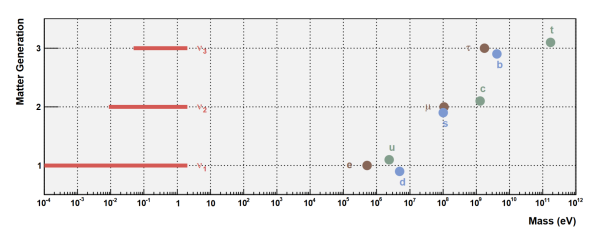
Non-zero neutrino masses lead us to expect one or both of the following to be true:
- There exist right-handed particles that do not interact via any known fundamental forces, but interact with neutrinos to provided masses via the traditional Higgs mechanism. Such particles, called heavy neutral leptons (HNLs) or sterile neutrinos, have never been observed to date. Their detection would be a game-changing discovery of new physics beyond the Standard Model.
- Neutrinos may be Majorana fermions – meaning, they may not have distinct particle/anti-particle states. This would allow neutrinos to obtain mass through a new mechanism (i.e. beyond the Higgs) and would only be possible for neutrinos, which possess no electric charge.
While these would be a relatively straightforward modification to the theory of elementary particles, they would have profound implications for fundamental physics. Sterile neutrinos would introduce be completely new particles beyond the Standard Model, and --depending on their mass -- could change our understanding of dark matter and the large-scale evolution of the universe. Majorana neutrinos would introduce a new mechanism for generating masses of elementary particles and would introduce new interactions that violate CP symmetry and the conservation of lepton number -- both of which could be key ingredients for explaining how matter was originally created in the Big Bang.
Our research aims to test these hypotheses using precise measurements of radioactive decays in nuclei. We search for rare processes that could only occur if neutrinos were Majorana fermions, and make high-precision measurements of final-state particles in nuclear decays to search for evidence of sterile states or other new particles coupling to neutrinos. Learn more about our research in the following pages.


